
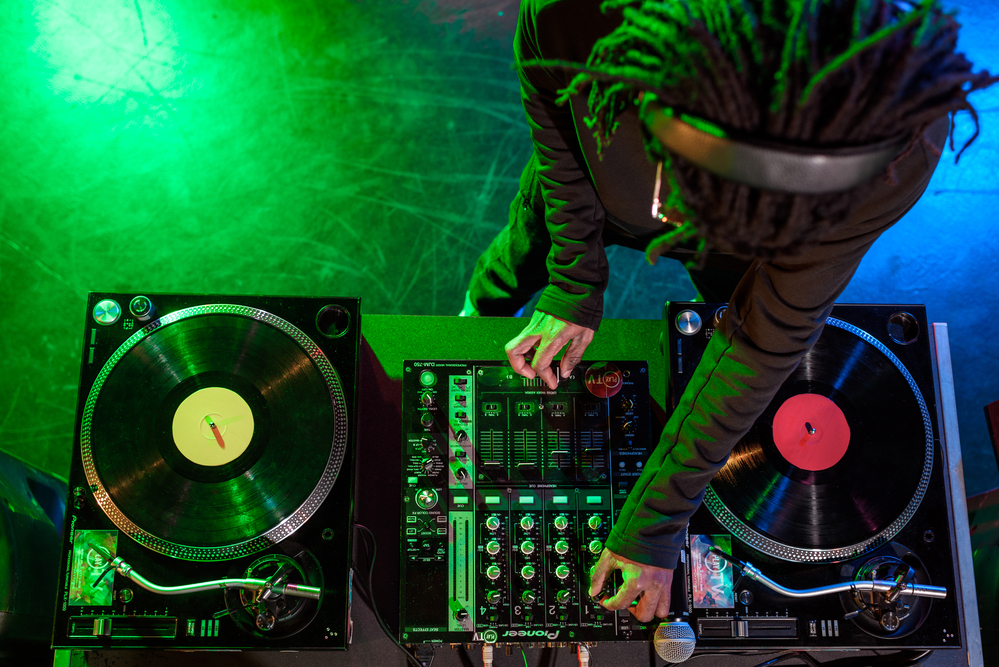
I’ve always thought of myself as an educational DJ. It’s the metaphor that, more than any other, captures what I actually do as a facilitator. Because at the end of the day, a DJ’s job is to create an experience where people are moved, literally, physically, emotionally moved. And a facilitator’s job is to create an experience where people are moved to learn. The skills required to do both of those things well are remarkably, almost uncannily, similar.
Curation Over Content Expertise
A DJ doesn’t need to have written every song they play. They don’t need to be a musician or a composer. What they need is taste, knowledge of their audience, and the skill to blend and sequence what already exists into something that works for the room in front of them.
Facilitators work the same way. We are frequently brought in to design and facilitate learning experiences on technical subjects where we are not the subject matter expert. We work alongside people who know the content deeply: seasoned practitioners, technical specialists, experienced leaders in their field. Our job is not to know what they know. Our job is to translate their expertise into a learning experience for others.
That means understanding the audience. What do they already know? What’s relevant to their actual work? What will land with urgency for them and what will fall flat? And then it means taking the subject matter expert’s content and asking: how do we transform this from a powerpoint lecture or a manual into something people actually experience, engage with, retain, and then apply?
A DJ explores similar questions: what is the desired vibe for this event? What genres and artists will resonate with this particular crowd to create that vibe? How do I sequence and mix those tracks to create the experience we’re going for?
Reading the Room and Adjusting the Set
A DJ who ignores the dance floor isn’t doing their job. If people aren’t moving, you read that. You adjust. You transition to something different. You trust your instincts about what this crowd needs in this moment, even if it’s not what you had planned.
In facilitation, we call this reading the room. And it’s one of the most important skills we have. Energy at the start of a workshop is probably going to different from the energy after lunch. Energy on day one is usually different from energy on day three. A facilitator who runs the same way through their agenda regardless of what the group is actually experiencing isn’t facilitating, they’re just presenting.
Reading the room means noticing when an activity is landing and leaning into it, giving it more time, letting it breathe. It means noticing when something isn’t working, when the energy has gone flat, when people look confused or disengaged, and being willing to cut it, modify it, or transition into something else entirely. Just like a DJ who smoothly moves from a track that’s clearing the dance floor to one that brings people back in.
The Break Beat: Rhythm, Ritual, and Return
One of the most foundational innovations in hip hop DJing was the break beat – isolating the percussion break in a song and extending it, looping it, creating a space for dancers to really go. It became the rhythmic foundation, the thing people could lock onto and return to.
In facilitation, we need break beats too. We need rhythm and ritual built into the learning experience – recurring structures that to which participants can anchor themselves. Something that says: ph snap! here it comes, we’ve been here before, we know this move, we do this together. It creates safety. It creates coherence. It gives people a moment to reconnect as a group before heading back out into new territory.
That might be a daily opening check-in. It might be a consistent closing reflection at the end of each session. It might be a physical warm-up ritual that the group does together before diving back into content. Whatever form it takes, the break beat in facilitation is the thing that brings people home before sending them somewhere new.
Flow, Transitions, and the Arc of the Set
A great DJ set has an arc. There’s an opening that sets the tone and draws people in. There’s a building of momentum through the middle. There’s a peak – that moment where the energy is at its highest and the room is fully alive. And then there’s a winding down, a return to something more reflective, a close that honors the journey people just took together.
Facilitation has the same arc. The opening is not just logistics. It’s establishing tone, creating safety, signaling to participants what kind of experience this is going to be. The transitions between activities matter enormously. A jarring shift can break the energy and trust you’ve been building. The peak might be a powerful activity, a moment of real collective insight, a conversation that goes deeper than anyone expected. And the close is never just a summary, it’s an invitation to integrate what happened, to carry something forward.
I’ve even learned to use music and sound, literally, in my facilitation work, such playing something upbeat to signal that it’s time to reconvene after a break, or something quieter and reflective to help the group settle into a more introspective activity. Ringing a singing bowl to bring small group discussion to a close and everyone’s attention back to the full room. The sonic environment is part of the facilitation. The DJ in me knows that what people hear shapes how they feel, and how they feel shapes how they learn.
In Service of the Experience
Here’s the thing about DJs that I think gets overlooked: they are completely in service of the crowd’s experience. The best DJs disappear into the music. You’re not watching them, you’re dancing. You’re not thinking about their technique, you’re feeling the music.
That’s the aspiration for facilitation too. The best workshops I’ve been part of, either as a facilitator or a participant, are ones where the facilitation becomes invisible. Where people are so engaged in the learning, so connected to each other and to the content, that they stop thinking about the person holding the mic or standing at the flip chart. They’re just in it. They’re learning and growing and building something together.
That’s what a great DJ does. That’s what a great facilitator does. And when you get it right, it feels like magic, even though you know it took everything you had to make it look that easy.
Introduction: Hip Hop and Facilitation
 Daryn R. Cambridge