Category Archives: Education/Training

Fall 2010 Semester Begins at American University

This fall semester, my dad and I will once again be teaching the course, Education for International Development. Each semester teaching this course (and this is our third), we are trying to find new ways to better engage the students with the subject, explore new teaching methods, and experiment with new online learning platforms.

In past semesters we have used the social networking service, Ning, which served our purposes pretty well, especially since it creates a Facebook type experience with which most students are familiar. However, Ning got rid of its free service, so we decided to use a different online platform to host our course discussions and materials and we chose wordpress.  Check out the class website to see how we set it up.
Continue reading

Draper Hills Summer Fellowship on Democracy and Development

This week I had the pleasure of delivering a presentation at the Draper Hills Summer Fellowship on Democracy and Development program at Stanford University.  Every year, the International Center on Nonviolent Conflict gives a series of presentations looking at the role of nonviolent conflict and civil resistance in mobilizing civil society to establish democratic self-rule, strengthen democratic institutions, and hold governments accountable.  I was joined by two of my colleagues at ICNC – Dr. Peter Ackerman (Founder) and Hardy Merriman (Senior Advisor).

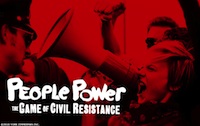
My presentation looked at a new, teaching and strategic planning tool ICNC has designed in partnership with York/Zimmerman, INCPeople Power: The Game of Civil Resistance is a serious, turn-based, strategy game that engages the user in the mental contest of organizing and waging a nonviolent movement.

Continue reading

Peace Education Course with DCPS Teachers

Great group of DCPS teachers, counselors and administrators participating in my peace education class

I just finished teaching a week-long (m-f, 9am-5pm) intensive peace education course at American University with 24 DC Public School teachers, counselors, and administrators.

The course is offered as part of the Alliance for Quality Urban Education, a partnership among key stakeholders in teacher education in the District of Columbia. The goal of AQUE is to improve student achievement through a comprehensive teacher preparation model, designed to support the ongoing development of a highly qualified teaching force.

It was such an honor to work with these dedicated and talented educators and to spend a week with them exploring themes such as community building, multiple intelligences, conflict resolution, nonviolent civic action, emotional intelligence, and a number of experiential and participatory methods of engaging their students in all these themes.

Download course syllabus.
Download sessions learning plans.

Professional Educators Workshop at UW-Madison

From June 28 – 29, I have had the distinct pleasure of facilitating a series of workshops at a conference for professional educators.  The conference, Nonviolent Civic Action around the World, was organized and hosted by the Global Studies Center at the University of Wisconsin, Madison.  I was invited to present by the United States Institute of Peace, an organization with whom I have worked in collaboration with my colleagues at the International Center on Nonviolent Conflict.  I also had the pleasure of designing and co-facilitating some of these workshops with another teacher trainer from George Washington University.

As the center’s website states, the conference is “a two-day development workshop for professional educators interested in understanding and teaching about international peace-building movements… The theme — Nonviolent Civic Action around the World — will appeal to educators broadly defined to include K-12 teachers, university educators, professional communicators, and college and university students training in these fields.

Continue reading

Fletcher Summer Institute for the Advanced Study of Nonviolent Conflict

Each year, the International Center on Nonviolent Conflict holds a week long course on nonviolent conflict and civil resistance at the Fletcher School for Law and Diplomacy at Tufts University.  Participants come from all over the world and from a variety of backgrounds.  This year we had participants from 5 continents, 25 countries, speaking 18 different languages, and professionals and/or organizers involved in various nonviolent struggles around the globe in places like West Papua, Palestine, Egypt, Nepal, India, Burma, Russia, Zimbabwe, Kenya, Mexico, and several other places.

I attended the Fletcher Summer Institute (FSI) last year, but only for a couple days, so it was a real treat to be able to experience the program in its entirety.  Also, being a staff member this year, as opposed to an observer last year, I had a lot more responsibility in helping develop, organize, plan, and facilitate the institute (during the week of the Institute, I put in 96 hours of work!).

Continue reading

ICNC Academic Workshop

This past week I spent three days in Atlanta, GA meeting and working with scholars, academics, and educators interested in teaching courses on civil resistance.

ICNC put together a two day workshop on the study and teaching of civil resistance with the input of some of the world’s top scholars in the field. Dr. Kurt Schock from Rutgers University presented his research on civil resistance movements for land reform in countries like India and Brazil.  Dr. Cynthia Boaz from Sonoma State University presented on the role of women in civil resistance movements and looked specifically at the women’s movement in Iran among other struggles.  Tom Hastings from Portland State University and blogger presented on the historiography of teaching and pedagogy of civil resistance.  Howard Clark, Chair of War Resisters International, presented on the conceptual foundations of disobedience and protest.  Stephen Zunes from San Fransisco University presented on current issues and controversies associated with civil resistance and looked at several cases, past and present, and some of the lessons learned from studying these movements.  And Les Kurtz from George Mason University presented on various ways educators could structure syllabi for courses on civil resistance.

Continue reading

Democracy Matters Board Member

Today I was unanimously voted in as a new board member of the Democracy Matters Institute.  Democracy Matters is an outstanding organization doing great work with young people on college campuses across the country.  I worked for Democracy Matters for two years, first as a regional field organizers and then as the assistant director.  It is an honor to stay connected with this organization in this new capacity and I look forward to contributing to their continued success.

Last Class of the Semester

Yesterday was the final class of the semester.  This marked the second time my Dad and I co-taught the class, Education for International Development (see post from beginning of semester).

The last three weeks of the semester were dedicated to the students working together in teams to analyze development challenges within a particular country and then design an education/training program that addresses those challenges.  My Dad and I use a fictional country called Afrinia – a country that faces a lot of challenges related to the topics we covered in the class – ethnic tension, inadequate access to education (particularly for women and girls), high levels of international debt, emerging from a civil war, monoculture economy, high rates of HIV/AIDS, and more.

Continue reading

Institute for Technology and Social Change

Today I agreed to serve on the advisory board of a great, new organization, the Institute for Technology and Social Change.

In this capacity I will assist an excellent team of social and technological entrepreneurs in developing online classes designed to train people in the use of digital tools, online applications, and social media to advance and enhance work in the field around issues of human rights, peacebuilding, conflict transformation, and disaster relief.

Democracy Matters Summit

This past weekend I had the honor of attending my third Democracy Matters student summit.  This year I facilitated three workshops:

(1) Organizing 101: How to Organize S.M.A.R.T. campaigns – This workshop looked at five ways campus organizers can think about their campaigns strategically.  The SMART model (slightly amended for the purpose of this workshop) asks if your campaign is Specific, Measurable, Advertised (adapted from achievable), Realistic, and Timebound.

(2) Winning Over Your Audience: Tips for Great Public Speaking – This workshop helped students organizers get comfortable speaking about money in politics and how it connects with other hot button issues.

(3) Interactive Audience Engagement Techniques – This workshops introduced students to a couple activities they can use to increase participation among their audiences.

Continue reading