ICNC/Rutgers University Online Course

From April 23rd to June 5th, ICNC partnered with Rutgers University to deliver a 6 week online course on civil resistance and the dynamics of nonviolent conflict. I was the primary designer of the course, having structured it off a similar layout I used for the online course ICNC did with USIP the previous year.  I was also a co-facilitator of the course with my colleague Maciej Bartkowski. There were 22 participants in the course from all over the world.  The partnership was encouraged and supported by one of ICNC’s academic advisors, Dr. Kurt Shock, who is an Associate Professor of Sociology and Global Affairs.

Continue reading

Producing a Social Media Show

Its fairly common these days to walk into a university classroom and see students equipped with some amazing gizmos, gadgets and tech giving them the ability to take pictures, record HD video, browse the internet, record audio, and publish content to social media sites.  It is fairly uncommon, though, to see those powerful devices being put to use in the learning process.

I set out to integrate these devises into one of our Education for International Development classes this semester.  The goal of the class session was to explore (i) the impact violent conflict can have on development, particularly the MDGs, (ii) the role education can play in creating or causing violent conflict, (iii) the role education (formal, nonformal, and informal) can play in building peace, and (iv) the role of technologies, both old and new, and social media in building peace through informal education.

Check out the Storify board to see the final product and to see what was discussed and shared during the class.  Continue reading to see how the whole process unfolded.

Continue reading

TC106 – New Technologies for Educational Practice

Above is the intro video Nick Martin and I recorded and shared to kick off the first iteration of TC106 – New Technologies for Educational Practice. I had the pleasure of co-facilitating this course with Nick and, as is always the case when working with TechChange, it was a fun and exciting experience filled with all sorts of new learnings, many of which you can find by checking out the Storify board I curated throughout the course. There you will find more than you could ask for in terms of content, and get a general sense of the various themes that were covered each week. Continue reading to see the course description and its learning objectives.

Continue reading

Peace Is Possible: A Peace Pedagogy Exploratorium

This past weekend I had the pleasure of co-facilitating a day-long workshop exploring peace education and pedagogy at George Mason University.  Peace educator, nonviolence trainer, and GMU professor, Arthur Romano, assembled the team of educators (pictured above), and the six of us facilitated the program described below:

“This day-long exploratorium gives students an opportunity to engage with a variety of peace pedagogies used by practioners in the field. We will be joined by first-rate peace educators who have worked in the US and abroad. They will guide us through a series of lecturettes and activities that promote deep introspection, personal story sharing, community building and provide opportunities to examine the importance of self-reflexive praxis in peace education. In all, the day will examine both critical and creative pedagogical approaches to the field and seek to provide a safe and experimental forum in which to explore alternative approaches to education.”  Continue reading to learn more…

Continue reading

Presentation at Point Conference in Sarajevo

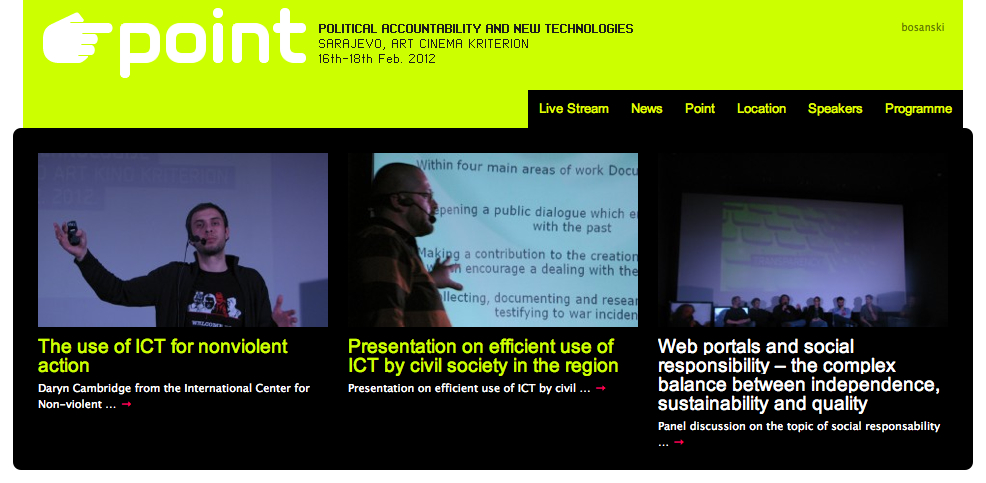
This past weekend I gave a presentation (via Skype) on the use of ICT for nonviolent action at the Point Conference in Sarajevo.  I was invited to participate by my friend, Darko Brkan, who had attended ICNC’s 2010 Fletcher Summer Institute.  You can learn more about Darko by checking out this On the Ground Interview I conducted with him a couple years ago.

My presentation looked at four main ways nonviolent movements have been leveraging ICT in their struggles – communication, mobilization, organizing/coordinating, and documentation.  Continue reading to watch and listen to a slidecast of the presentation…

Continue reading

American University Skills Institute on Civil Resistance

This past weekend my colleague, Maciej and I co-faciliated a skills institute at American University titled, “People Power: How and Why Civil Resistance Works.”  We had 15 participants from a variety of backgrounds and covered a range of topics: history of civil resistance, conceptions of power, the role of media in civil resistance, frameworks for deciding how one considers what is violent vs. nonviolent,  tactical innovation, backfire, and dilemma actions.

Click here to download the full course syllabus.

11th Annual Democracy Matters Summit

This past weekend I was in Albany, NY attending my sixth Democracy Matters summit.  This year the summit brought together over 90 students from across the country to learn more about the role of money in politics, grassroots organizing, and to strategize about ways to engage other students and community member in the campaign to get big money out of politic and put people back in.  Continue reading to learn more…

Continue reading

USIP/ICNC Online Course on Civil Resistance

From October 20th – December 8th, ICNC partnered with the United States Institute of Peace to deliver an online course, Civil Resistance and Dynamics of Nonviolent Conflict.  I was the primary designer of the course and, with the help of three of my colleagues, co-facilitated the eight-week course for 15 participants from all over the world and from a variety of professional backgrounds.  We had participants from Italy, Spain, Ghana, Egypt, West Papua, and the United States.  We had participants working for small NGOs, large international institutions, and graduate students.

This was the first fully online course that ICNC and USIP had ever facilitated and I can say with confidence that it was a success.  One of the participants, who is an educator herself, in their final evaluation shared that her experience taking this course was, “adult learning at it’s best.”  To highlight some of the ways the course was designed I reference a blog posting titled, 5 Ways to Enhance Your Social Presence in Online Courses.  I came across this article soon after the course ended and was pleased to see that we incorporated pretty much all of these suggestions.  Continue reading to learn more…

Continue reading

Peace Education Master Class

From December 2-4, I was one of 8 participants in a peace education master class facilitated by two of most prominent peace educators in the world – Betty Reardon and Tony Jenkins.  The class was held at the La Casa de Maria Retreat and Conference Center located in the coastal mountains of Santa Barbara, CA.  I had first met Tony Jenkins at the National Peace Academy’s Peacebuilding Peacelearning Intensive back in July of this year.  As my blog posting from that intensive describes, it was a inspirational and transformative experience where I got to learn from and work with a number of peacebuilders.  I had met Betty Reardon briefly at the Gandhi-King Conference back in October, but this was the first time that I had an opportunity to actually take a class with her.  So needless to say this opportunity was a dream come true and it did not disappoint.   If you want a quick, tweeted, overview of some what we covered and discussed throughout the class, check out my Bundle of key tweets and resources.  Continue reading to learn more…

Continue reading

American University Alumni Human Rights Panel

On Thursday, November 10th I was a panelist for an alumni panel at American University.  I was joined Maryanne Yerkes who is a Democracy Officer at USAID.  We spoke about our respective careers, how they are related to the field of human rights, how our American University experience helped prepare us professionally, and any advice or tips for students interested in pursuing similar professions.

I felt that the work I do at ICNC and Maryanne’s work at USAID had a lot of similar components, which turned the conversation into an interesting look at nonviolent civil resistance as a method to demand and win rights, freedom, and democratic self-rule.

Continue reading