Global Day of Action on Military Spending

Today I participated in the Global Day of Action on Military Spending –  a global effort to draw attention to the amount of money countries spend on defense, war, and their military vs. other issues and human needs like clean water, basic sanitation, primary schooling for all, eradication of HIV/AIDS and other major diseases, etc – all of which can be accomplished by spending just a small fraction of what the world spends on war-making.  My good friend, mentor, and fellow peace educator, Barbara Wien, invited me to facilitate a session on peace education and nonviolence during a teach-in event that was held during the day of action on American University’s campus.  The goal for our session was for attendees to not just be aware about how much money is spent on war-making and the nefarious interests that profit from it, but to actually start thinking about alternative approaches, specific actions, and examples of how people, communities, and government’s can create security, fight for human rights, and advance social justice, without violence and war.  Continue reading to learn more about the day and the issue.
Continue reading →

AU Social Learning Summit

In the spirit of this summit, I decided to blog about the different panels I attended by copying what I thought were some of the key tweets that other participants had been sharing during our #sls11 “communal note taking.”  I was a panelist for the Peace through Tweets sessions and really enjoyed talking about the various ideas and debates within that field.

Continue reading →

Capital Area Association for Peace Studies (CAAPS) Keynote Address


This weekend I had the privilege of giving the keynote address at the 24th annual Capital Area Association for Peace Studies student conference.  It was such a pleasure speaking with all the students and then attending several of their project and paper presentations.  I also enjoyed putting together my remarks because it gave me an opportunity to (1) explain how the work of peace scholars is transforming the world and why that is important and (2) how my work in the field of nonviolent conflict and civil resistance in increasingly influencing the interest in peace studies.  Click above to listen or click read more below to read my remarks.

Continue reading →

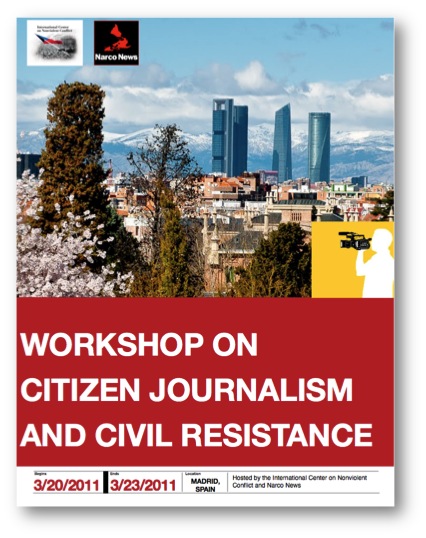
Workshop on Citizen Journalism and Civil Resistance

For the last six days I was in Madrid, Spain to help facilitate a workshop that married the two fields of citizen journalism and civil resistance.  The goal of the workshop was to prepare journalists, bloggers, and communicators from around the world to better understand the strategic dynamics of nonviolent social movements so they can more effectively report on these struggles in ways that will help them to succeed.  26 citizen journalists participated in the workshop coming from the following countries: Azerbaijan, Afghanistan, UK, Phillipines, Mexico, Spain, Israel/Palestine, Brazil, Yemen, Bahrain, Egypt, Macedonia, Ukraine, India, Sri Lanka, Lebanon, Serbia, France, and Finland.

Continue reading →

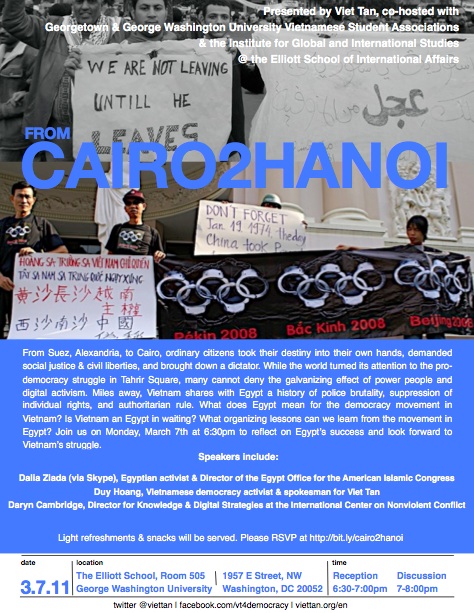
From Cairo2Hanoi Panel Discussion

Yesterday I participated in a panel discussion event organized by Viet Tan – an organization that engages in actions that empower the Vietnamese people. Specifically, they seek to roll back existing restrictions against two key human rights: freedom of expression and freedom of association and assembly. These enabling freedoms are the pillars for civil society (Viet Tan).

The event looked at the role of social media in the nonviolent uprisings in Tunisia and Egypt and whether or not there are any relevant connections that can be made between those who engaged in civil resistance and digital activism in Tunisia and Egypt with those who continue to struggle in Vietnam.  I had the pleasure of speaking alongside to amazing activists and organizers.  Continue reading to learn more…

Continue reading →

The Social Revolution

This week I gave a couple a couple talks at Rutgers University.  I was invited by Dr. Kurt Shock, who is an associate professor of sociology and global affairs at Rutgers and is one of ICNC’s academic advisors.  I first spoke in his colloquium course, where I gave a presentation titled, The Social Revolution: Digital Media, Cyber-Pragmatism, and Nonviolent Movements, which I will outline in greater detail later in this post.  The second presentation I gave was to his undergraduate class on social movements, where we looked at the role of the internet and social media in social movements more broadly.  In both presentations I used the uprising in Egypt as a case study in exploring these themes.

Continue reading →

Training for Change Workshop – How to Teach Theory

From Thursday, Feb 24 – Sunday, Feb 27, I attended the Training for Change workshop, How to Teach Theory.  This is the second TfC workshop in which I have participated.  The first was their Training for Social Action Trainers (TSAT), which I found to be a highly effective, engaging workshop that helped me develop new skills as a trainer and educator in ways that made it more likely that I would actually use these skills in my professional work.  One of the TSAT trainers recommended that I take the How to Teach Theory workshop, considering both my work for ICNC and at AU – two teaching and training settings that require exploring theories and abstract ideas.  The goals of the workshops were: (1) increase your skills at presenting theory and concepts without lecturing, (2) gain confidence and experience in moving a group from stage 2 (reflection) to stage 3 (generalization) to stage 4 (application) in the direct education model/experiential learning cycle, (3) Identify key teaching concepts and theories in your teaching area, and (4) have fun!  Below I have outlined what was covered in the workshop and some thoughts on why I think they are important.

Continue reading →

Key Insights from Clay Shirky’s Book, “Cognitive Surplus”

Imagine treating the free time of the world’s educated citizenry as an aggregate, a kind of cognitive surplus…One thing that makes the current age remarkable is that we can now treat free time as a general social asset that can be harnessed for large, communally created projects, rather than as a set of individual minutes to be whiled away one person at a time.

…young populations with access to fast, interactive media are shifting their behavior away from media that presupposes pure consumption.

The social uses of our new media tools have been a big surprise, in part because the possibility of these uses wasn’t implicit in the tools themselves…the use of social technology is much less determined by the tool itself; when we use a network, the most important asset we get is access to one another.  We want to be connected to one another, a desire that the social surrogate of television deflects, but one that our use of social media actually engages.

Access to cheap, flexible tools removes many of the barriers to trying new things.  You don’t need fancy computers to harness cognitive surplus; simple phones are enough.

Continue reading →

2011 Democracy Matters Summit

This past weekend I returned to Albany, NY to participate in my fifth consecutive Democracy Matters summit and it never ceases to be an educational and inspiring experience.  A special part of this year’s summit was that DM’s president and founder, Adonal Foyle, was able to attend and give the keynote address.

Continue reading →

Spring 2011 Semester Begins at AU

The spring 2011 semester at American University has begin and my dad and I continue to teach EDU285 – Education for International Development.  This semester marks the fourth time we’ve taught this course and we are continuing to find new ways to make the class better – introducing appropriate amounts of content, incorporating a diverse set of activities and exercises, and utilizing new online tools to enhance student learning.  This semester there are three main changes from previous semesters: (1) a Twitter feed (@AUedu285) to follow stories related to education and international development, (2) a website redesign, and (3) more guest speakers.

Continue reading →