National Peace Academy’s Peacebuilding Peacelearning Intensive

From July 17th – 24th, I attended, along with approximately 45 other participants from around the world, the National Peace Academy’s Peacebuilding Peacelearning Intensive, held on the Champlain College campus in Burlington, VT.  The goal of the intensive was to “nurture your holistic development as a peacebuilder by engaging in deep reflection and critical inquiry into your own worldviews, values, principles, and assumptions…In supporting the development of peace systems we [NPA] will engage you in a reflective and integrative planning process that will culminate in the development of your own unique, ‘Peacebuilding Plan Proposal.'”

This was a truly transformative experience and one of the best workshops/community gatherings in which I have ever participated.  The diversity of people that were in attendance, the quality of presentations, the power of the reflective processes, and the community that was built around our visions for peace was something that furthered my commitment to the beloved community of peacebuilders and peacelearners across the globe.  Continue reading to learn about my experience over the five days.

Continue reading →

How to Ignite, or Quash, a Revolution in 140 Characters or Less

On July 13th, I attended an event at the New America Foundation: How to Ignite, or Quash, a Revolution in 140 Characters or Less, which looked at the promise and limitations of technology in spreading democracy. July 13th also happened to be my birthday, and one of the most special messages I received that day came in the form of a tweet from Ghada Shahbender (@ghadasha), an Egyptian human rights activist and one of this year’s winners of the James Lawson Award.

Continue reading →

Learning to Teach Online (LeTTOL)

I recently completed my participation in the online course, Learning to Teach Online, offered through Sheffield College in the UK.  A friend of mine recommended that I take this course a couple years ago and I am glad that I finally found the time to actually do it.  The course began in late February and finished in early July, which was a perfect time for me to delve into this field as I am in the process of designing an online course on nonviolence that I will then be facilitating in the fall.

I learned a tremendous amount about effective online teaching.  Continue reading to see some of my key take-aways.

Continue reading →

2011 Fletcher Summer Institute

From June 19-24, I attended, helped organize, and presented at the 2011 Fletcher Summer Institute for the Advanced Study of Nonviolence Conflict. This yearly institute is the only professional level course of its kind offered in the world that explores the strategic use of nonviolent civic action – strikes, boycotts, mass demonstrations, civil disobedience, etc. – as a method of fighting for and defending human rights, social justice, and democratic self-rule.

This year the institute brought together 45 participants from 26 countries and delved into topics such as forming a movement, the paradox of repression, citizen journalism and movement media, negotiations and transitions, and the role of third party actors in supporting civil resistance movements. My colleague, Nicola Barrach, and I co-presented a session on digital and social media in civil resistance, which looked at the uses and limitations of digital technology, social media, and the internet in waging nonviolent struggle.

In addition to presenting, I also helped coordinate various media elements of the institute by integrating the use of our FSI alumni network Facebook group page as a platform for continued discussion and resource sharing; organizing live, communal note-taking on Twitter with the #fsi11 hashtag; curating and sharing key tweets and resources mentioned during the different sessions using Bundlr; recording audio interviews with participants and presenters and sharing those recording on Twitter using Audioboo; and conducting longer video interviews with select participants and presenters for the ICNC website and our On the Ground Interview Series.  Needless to say, I did not get much sleep, but I did have a great time, learning a lot from some amazing organizers, activists, and educators!  Continue reading to learn more about the institute, the various sessions, and some of the key take-aways from each.

Continue reading →

SCA Conflict Resolution Workshop

This Tuesday I teamed up with a friend and fellow peace educator, Tarek Maassrani, to co-facilitate a conflict resolution workshop for 45 crew leaders in the Washington DC Department of the Environment’s Green Zone Environmental Program (GZEP).  We were sub-contracted by the Student Conservation Association – an educational and environmental non-profit that works with youth across the country on conservation and trail building.  They also work with GZEP in coordinating a series of workshops on leadership, conflict resolution, trailbuilding, and teamwork to orient GZEP crew leaders and prepare them for the program.   Learn more about what we covered in the workshop.

Continue reading →

4th International Conflict Resolution Education Conference

I just attended the 4th International Conflict Resolution Education Conference, which was held from June 8 – 11 in Cleveland, OH (download full conference program).  Educators from the United States and all over the world – Korea, Ghana, Kenya, Trinidad & Tobago – gathered at Cuyahoga Community College to participate and present a number of key workshops.  I was joined by my colleagues, Hardy Merriman and Maciej Bartkowski from ICNC.  I facilitated a session titled, “Liberation Tech? The Influence of the Internet and Digital Activism in Nonviolent Struggle.”  Continue reading to learn more…

Continue reading →

2011 Personal Democracy Forum

What do you get when you bring together some of the leading thinkers, activists, scholars, hackers, writers, and designers in the fields of social media, open-source and digital technology?  You get the 2011 Personal Democracy Forum.  Luckily, this year I was one of 1,000 attendees to participate in this yearly gathering to learn from and network with these brilliant minds and innovative creators.  I also had the pleasure of enjoying this conference with two of my ICNC colleagues, Nicola Barrach and Althea Middleton-Detzner.  While we were there we also got to meet up and hang out with our friends Eric Stoner, Bryan Farrell and Nathan Schneider from Waging Nonviolence, Katie Halper from Living Liberally, Matthew Slutsky from Change.org, and our friends Emily Jacobi, Mark Belinsky, and Biz Ghormley from Digital Democracy.   In addition to getting see our friends, we also saw some great presentations.  Click through to learn and see more about some of my favorite presentation from the conference.

Continue reading →

School of Authentic Journalism

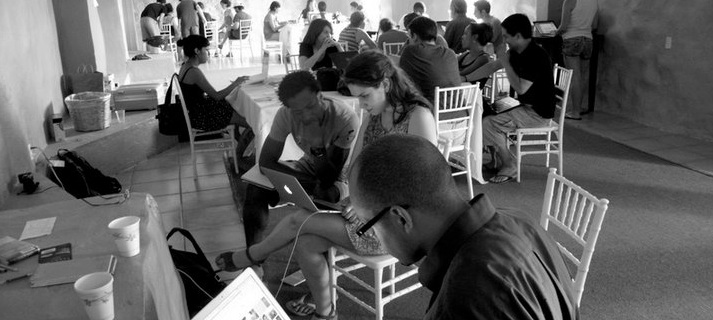
From May 11-21 I was one of 79 journalists, organizers, and educators who gathered in the State of Morelos in Mexico to attend the 2011 School of Authentic Journalism.  The school takes a unique approach – both with content and structure – in exploring the field of journalism, particularly in its role covering social movements across the globe.  The school was founded and is organized by Al Giordano, the editor of Narco News and a man who started organizing at a young age as part of the anti-nuclear power movement in the United States.  Check out this interview I conducted with him in 2009.  The school consisted of a mixture of plenary sessions where we got to hear seasoned journalists from a variety of mediums (video, photo, and print), contemporary organizers and veterans from nonviolent movements, and scholars of civil resistance.  Below I outline an extensive overview, going through each day, of what I experienced at the school along with links to others’ reflections and articles about the participants and the school.

Continue reading →

AU Spring Semester Ends with Pecha-Kucha

Even with a whopping 58 students in the class, the spring semester has flown by.  Since we like to elicit a lot of participation from the student, facilitate a lot of group activities, get the students moving around, and playing around with different learn space set ups, an increased class size, in a room with auditorium style fixed seating, made for some teaching and facilitation challenges.  But my dad and I made the necessary adjustments and, as far as I can say, had a good time working, yet again, with another group of AU students.

As we’ve done in the past, we ended the semester with students working in teams to design a education/training program that seeks to address one of many development challenges facing the finctional country of Afrinia.  The teams then present their program to the rest of the class, specifically addressing questions related to the major themes and concepts covered during the semester.  We did a little something different this year, however, with the presentations – we asked each team to put together a pecha-kucha presentation.

Continue reading →

Presentation for the One World Youth Project

This past weekend I gave a presentation on skills and approaches to teaching and facilitation for the One World Youth Project (OWYP).  OWYP is a great non-profit educational organization that links schools globally in service-learning to prepare the next generation for the globalized 21st century. In service of this mission they train college and university students  to go into local high school and middle schools to teach and implement elements of the OWYP curriculum which focuses on exploring the Millennium Development Goals and other global issues.  My presentation was filmed and will be put online to be used as a resources for college students who are “educators in training” interested in learning more about specific education approaches and teaching techniques that can help them be creative, culturally aware, and effective facilitators for OWYP.  Continue reading to check out my remarks.

Continue reading →